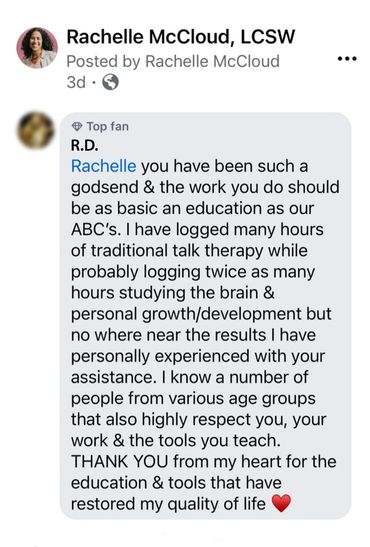
You understand a lot about yourself.
You may know where the anxiety comes from. You recognize the pattern. You can see when you’re people pleasing, shutting down, overthinking, taking something personally or getting pulled into a reaction you don’t want.
You may have already done therapy, read the books, learned coping skills and worked hard to change.
And some of it helped.
But there are still things you wish would simply stop happening.
I help people work through and resolve anxiety symptoms and the patterns connected to them, so they can spend less of their life managing what keeps happening and more of it actually living.

Kirsten
Maybe therapy helped you understand yourself.
Maybe you know exactly why certain situations affect you.
Maybe you’ve learned how to calm yourself down, challenge your thoughts, set boundaries or get through difficult moments.
That matters.
But if the same reaction keeps returning, there may be another part of the work to do.
Because understanding why an anxiety symptom happens is not the same as helping your brain process what is still producing that symptom.
And becoming better at managing a symptom is not the same as having the symptom resolve.
You may not need another explanation for why you feel this way.
You may need a different way to work with what keeps happening.
After years of living with the same anxiety, reactivity, shutdown, self-doubt or emotional pain, it can start to feel personal.
You may find yourself thinking:
I’ve always been this way.
I should be able to handle this by now.
Why can I understand it and still not change it?
Maybe this is simply as good as it gets.
But a pattern that has been happening for a long time is still a pattern.
A reaction that feels automatic can still change.
And something that has become familiar enough to feel like part of your personality may still be connected to processing your brain hasn't been able to complete.
The question becomes less:
“What is wrong with me?”
and more:
“What does my brain still need to process so this anxiety symptom can actually change?"
Coping matters.
Regulation matters.
Understanding matters.
Sometimes you need all three.
But they are not the endpoint.
If anxiety keeps taking over the same situations, if one comment can still send you into hours of replaying a conversation, if you keep abandoning yourself to keep someone else happy or if your body keeps reacting as though something is dangerous even when you know better, I want to know:
What is producing that reaction?
That is what we use the anxiety symptom to help us find.
Then we support your brain in processing what it couldn't before. And then we return to the original problem and see what actually changed. Because the exercise is not the outcome. The change in your life is the outcome.
I don’t begin by assuming you need to dig through everything that has ever happened to you.
And I don’t assume that deeper, harder or more painful automatically means more effective.
We start with what is actually happening now.
A symptom.
A reaction.
A trigger.
A body sensation.
A belief.
A situation that keeps going badly.
A pattern you are tired of repeating.
These hold all the information we need.
Then we identify the part of the symptom your brain needs to work with and approach it in a way your brain can successfully process.
We support the processing.
Then we return to that part of the original anxiety symptom, trigger or reaction.
We notice what begins to move.
What changed?
What remains?
That tells us where to go next.
Sometimes the next piece is smaller.
Sometimes we need more distance.
Sometimes another part of the problem becomes obvious.
The work stays responsive to what your brain is actually doing rather than forcing you through a predetermined emotional excavation.
And when we have processed what we can find, then we go back to the original problem where it shows up in your life and we see what happens there.
Maybe we'll find a few more pieces that need to be worked through, or we'll find that the symptom no longer shows up at all.
The goal is not simply to understand yourself better.
The goal is that the things that used to interfere with your life interfere less and less or stop happening altogether.
Maybe:
Those changes matter because they give something back to you:
your attention, your energy, your relationships, your choices and more of your life.


One of my clients, Kirsten, had already spent years working on herself.
Therapy had helped. Other things had helped.
But she described reaching what she called a “medium place.”
She understood a great deal about why she felt the way she did, but some of the actual problems were still happening.
During our work together, she began noticing significant changes early.
One of the first things she reported stopping were her panic attacks.
Her husband noticed that she seemed different.
And as the work continued, she began responding differently to herself, her son and difficult situations in her life.
Her distinction became simple:
“Knowing it and knowing why it’s there doesn’t actually solve it.”
That is an important distinction in my work.
Understanding can be part of processing. But I want to know what the processing actually changes.
A lot of the people who find me are capable people.
They have learned to function through a lot.
They can work, parent, care for other people, solve problems and keep moving even while a tremendous amount is happening internally.
That ability is a strength.
It can also hide how expensive the problem has become.
You may be using enormous amounts of energy to:
Getting by can become a full-time internal job.
And at some point, getting by may stop being good enough.

You want to be able to be where you are.
To enjoy your family while you’re with them.
To have a hard conversation without losing yourself.
To trust your decisions.
To rest.
To receive love.
To pursue something you want without your own brain pulling you back.
To make a mistake without turning against yourself.
To have energy available for creativity, relationships, work and the life you are building.
To stop wondering how much more you could be doing if so much of your capacity weren’t tied up managing what happens inside you.
You want your life to feel like your own.
That is what the brain work is for.
I’m a Mental Health Therapist and Emotional Wellness Coach.
For years, I’ve worked with people experiencing anxiety, depression, traumatic stress and complex emotional patterns.
My work developed from one question I kept coming back to:
Why can someone understand a problem so well and still keep experiencing it?
I became deeply interested in what changes when we stop asking people only to understand, control or cope with what is happening and instead begin helping the brain process what it is trying to work through.
My work draws from approaches including Emotional Freedom Techniques, Thought Field Therapy, EMDR and Eden Energy Medicine, along with years of clinical experience and continual observation of what actually changes for people.
I’m interested in results you can notice.
Not simply:
“That was a powerful exercise.”
But:
“The thing that used to happen isn’t happening the same way anymore.”
.png/:/rs=w:400,cg:true,m)
You have already spent time trying to help yourself.
You are thoughtful and self-aware.
You’re willing to participate in your own change.
And you keep finding yourself face-to-face with something that says:
I know what is happening. I just can’t make it stop happening.
You might be dealing with anxiety, depression, traumatic stress, overwhelm or patterns such as:
You do not need to arrive knowing exactly what is underneath it.
Bring the problem.
We can begin there.
You do not have to know your entire healing plan before you take the next step.
Start with the thing that keeps happening.
The anxiety.
The reaction.
The shutdown.
The thought loop.
The situation you keep getting pulled into.
The pattern you are tired of living around.
You don’t have to spend the rest of your life getting better at living with something you want to resolve.
There may be work your brain still needs to do.
And you can begin learning how to help it do that.

For people who want a clear process they can learn and apply on their own.

If you've already been working on an anxiety symptom but aren't sure what your brain needs to work with, what may be interfering with processing, or what to focus on next, a focused consultation can give you direction.

For people who want direct guidance, feedback and support while doing deeper or more complex work.

For clients located in Oregon who are looking for therapy and want to work with these approaches within a clinical setting.
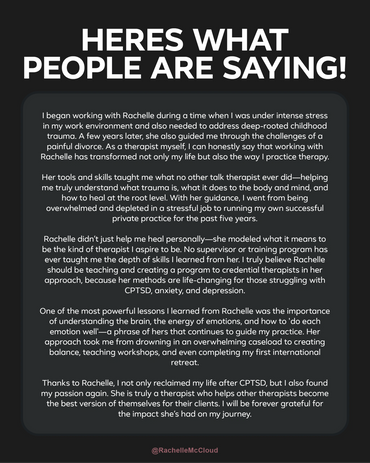
If you want to understand more about how I think about symptoms, processing and the brain, these are good places to begin (Click the title of the topic you're interested in):
When You Have Lived Your Life in Survival Mode - Why everyday life can become so difficult when so much of your system is occupied with survival.
How to Feel Safe Again After Trauma - A deeper look at safety, regulation and what can change as the brain becomes increasingly able to process.
Trauma Processing - What processing can look like and some of the changes that can tell you something is beginning to move.
You Don’t Have to Be Smarter Than Your Brain - Why working harder to think your way out of a reaction is not always the answer—and what it can mean to work with your brain instead.
Copyright © 2023 Rachelle McCloud, LCSW - All Rights Reserved. Privacy Policy
This website uses cookies. By continuing to use this site, you accept our use of cookies.